Social Network Rehab
Table of Contents
I had a doom-scrolling addiction. This results in hour-long bathroom breaks, sleepless late night where I just mindlessly scroll through Facebook, Youtube and the likes. It had a hugely detrimental effect on my attention span and sleep quality.
Not anymore, I said this to myself. I decided it was time to start seeing this seriously as a true addiction and deal with it accordingly.
The proposition of social networks
Social networks are being less and less useful nowadays. Back when I first started using Facebook, my friends are there. I can actually see the posts of my friends at the top of the news feed. The posts I saw was relevant. Facebook also function as a search engine for public discourses, a kind of marketplace where I can find communities that trade in the stuffs I’m interested in (used to be mechkeys, audio equipment, computer stuffs). To be honest, at the current moment Facebook still can be used for the stuffs I just mentioned, but the relevance & the quality of the stuffs I found on Facebook is degrading at an alarming rate. I usually cannot find the thing I’m looking for quickly enough. I keep seeing posts from people I never know before. Also, good luck finding your friend by name on Facebook 💭 💭 Since they are tracking us super extensively, how about they account the position of the user into the searching? Like if I’m searching for the name of the guy sitting next to me, it should probably be visible in the first page. , you will probably find truckloads of people with their names slightly similar to who you are searching for.
The same problem plagued every other social media networks I have used. In the early day, they were groundbreaking media to help me connect with people with the same interest. Gradually, I cannot see and find relevant stuffs on the site in an organic way anymore.
Perverse incentive
This is a deeply iterated problem on public discourse, but it is worth mentioning it here again. How do social media networks make money then? Simply put, all of them gain the majority of their wealth through advertisement. Advertising businesses pay them for audience views, so the logical thing for social networks to do is to maximize your screen time in order to show you more ads. So this explains the problem I stated above; like, if you are able to find the stuffs you need quickly, then you wouldn’t spend more time on the app, which means less ads you would see, which means less ad revenue. So they put in billions of dollars for the recommendation systems, to just show you slightly entertaining things to keep you on the platforms longer.
The platform works so well, in fact. The machine learning approach coupled with huge amount of usage data collected throughout the years allows the system to uncover what would interest a viewer. The reaction from the audience would be fed back into the algorithm, further reinforcing it. As a matter of fact, the algorithm from Tiktok or Facebook knows more about you than you would do. They would eerily suggest content that you will unfailingly like, just because it saws other people similar to you also like that kind of content. And before you know it, you spent 2hrs plus scrolling through short form videos.
The digital crack-cocaine pandemic
After a while, I realized I’m starting to develop a dependency on short form videos. As in, I needed to scroll through them at least 2 – 3 hours a day. I would open Facebook, instinctively, on my phone, whenever I’m bored, whenever I sit on the toilet, before I sleep. Whenever I open a link to Facebook or Youtube, I’ll invariantly be gravitated towards the shorts section where some pretty interesting thumbnails started piquing my interest. The worst thing is that, I usually had a reaction akin to withdrawal syndrome when I am not allowed to scroll as I please, for example, when my partner take away my phone during bathroom breaks. It sounds like an actual drug addiction isn’t it?
Well, as a matter of fact, it is exactly like a drug addiction, especially when it comes to short-form content. The videos inject your brain with a fast dosage of dopamine, which, on its own, isn’t much. But because it comes in rapidly and regularly, your brain starts to develop a taste for it, in the same mechanism as with puffing a cigarette or getting high on cocain 💭 💭 Well obviously I haven’t tried cocain before, this is not a first-hand account. . Next thing you know, you are a junkie, jumping from high to the next high.
Rehabilitation.
The first wake up call came to me one day when I realized at 4 o’clock in a morning that I have been scrolling non-stop since 11PM. My arms were numb from holding the phone up, my stomach is churning, yet my eyes stay fixed on the screen. I catch myself swiping through the 500th something video, then put the phone down, thinking to myself this has to stop. I didn’t stop, yet.
The second wake up call came when I was scrolling down HackerNews 💭 💭 At least it is a more healthy mode of scrolling, compare to Facebook and I saw a post about turning an iPhone into a dumbphone. I was certainly impressed with the idea, however it requires setting up from a factory-reset phone. At that moment I have no intention to do that, so I just merely bookmarked the post.
The second wake up call came when my phone’s charger port broke down and I have to send it in for check. The shop asked me to wipe the phone, and during the wipe, I suddenly recalled the post. Surely this would be a great time to start applying this methodology into practice. So after I got the phone fixed, I installed Apple Configurator and start configuring the phone just like an enterprise device.
A less-smart phone
Apple Configurator allow you to configure Device Management. Usually it is for putting on various restriction on the device, so the main users are companies before handing out Macs to their employees, or schools preparing iPads for their students. However, Stepan, the author of the aforementioned post, realized it would be good idea to apply the same kind of restriction on your phone. I applied his recommendation, with a major difference: I wouldn’t use an whitelist approach to websites. After all I would only get addicted to scrolling on Facebook or Youtube, so I only need to block those two sites, so I opt for an blocklist method, using the Built-in: Limit Adult Content. A plus
💭
💭
maybe?
for this is that I got porn-site blocking by default.
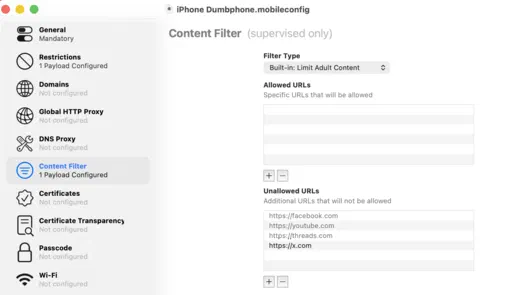
The effect is immediately felt. During the first day of using the phone, I usually find myself navigating to Facebook, again, instinctively. But being greeted with a “this site is restricted” screen really break the feedback loop in my brain, so after just 1 day I started to lose the urge to open Facebook on my phone. Not being able to view some Youtube videos on my phone is rather inconvenient, I feel like if it is really urgent I can view it on my laptop anyway.
Not being able to install application feels weird at first, but gradually after about 2 days, I managed to install all the apps I needed on a daily basis. The fact that we lock down the app list means there won’t be a random app around that I inadvertently install. I have to be fully conscious of the act of installing whenever I need to add a new app.
The adblocker method
Even when the sites like Facebook or Youtube are chock full of poisonous content, it is still very useful and I still need to be able to access it from time to time. An outright block of these sites are not feasible, I would still need to access them time after time.
For the past 2 years, I have been using the extension “News Feed Eradicator”.